Showing posts with label Mechanical Engineering Articles. Show all posts

Friday, 10 December 2021

Lupine Publishers| Pivotal of Artificial Intelligence for Next Level Medical Practices

 Lupine Publishers| Journal of Robotics and Mechanical Engineering

Abstract

Now a Days Artificial Intelligence (A.I) Science, technology and Engineering near to peak point with spreading lot of new opportunities, facilities, and possibilities to make human life more to most comfortable and easy. Hence same also applicable in medical researches and practices zone. Below I have showcased one informative model to discuss what are the possibilities, Opportunities and openings of A.I in the medical fields.

Keywords: Deep Mind, AI, USN, SAI, UAI, loT, RFID

Abbreviations: AI: Artificial Intelligence; USN: Ubiquitous Serving Networks; IoT: Internet of Things; RFID: Radio Frequency Identifications; NLP: Natural Languages Processing; DSS: Decision Support System

Short Communication

It is really correct to say manmade AI become more advanced from God made Natural Intelligence (NI) because of high degree of sensation, accuracy and task with high speed, calibration and precise control with time management, therefore not now, but from very beginning stage A.I widely used and implemented in medical practices and healthcare related diagnosis and treatment, but scope was limited [1-3]. Hence now a days due to next level advancement in A.I with high speed processors, U.A.I, S.A.I, Bionic processors, Deep Mind learning, machine learning advanced natural languages processing (NLP), Image processing, speech / smell scanning and recognition it’s became most useful in medical practices and researches and acting as backbone of it as display in model like A.I based body organs implant like Artificial heart, lungs, kidney, eyes, etc. Another Useful domain is cyborgs/ cybernetics or simply “cybermatics organs” where disabled human body parts replaced with A.I based parts or sometime replacement for the reason to boost power like cyborg hand, legs etc. next one domain to focus robotics surgery and external body operation of patients with precise control and accuracy in less time [4].

Now days instead of manual or semi-automatic control fully A.I control life support system engineered for precise monitoring and save lives. Not only A.I based hardware’s, but also A.I based medical software are engineered like medical diagnosis support system to examine various parameters and symptoms of patients like viral infection, root causes of diseases, blood pressure , heart beats monitoring as well as same system has inbuilt decision support system(DSS) to provide alternative treatment decisions to doctors after examine /checkups [5-7]. At several places where lack of physical doctors availability A.I based artificial doctors possible to engineer with various specialist like, nephrologist, gynecologist, cardiologist etc. which are the prototype of successful doctors with their natural intelligence (N.I) mapped and engineered with Artificial Intelligence which function exactly same like original one , hence availability of single one successful doctors skills / expertise of several places artificially . It is also possible and happened to A.I based Nano robots which insert inside the body for complicated scanning/ tracing and diagnosis where external mechanism fails to do so [8]. In last I would like to switch your attention towards the field in which you can refer my papers available online, using A.I and IoT in this concept A.I based software through IoT can perform same surgical operation around the world hospital stations with commands and controls successfully using RFIDs and USN Connected with satellite and IoT [9] (Figure 1).

Figure 1:

Acknowledgement

I would specially acknowledge this work to my Sister Azra Sadiya who helped me while I am preparing script for typing help due to my busy schedule. I would like to credit this work to my loving wife Safeena Khan, my angels Md. Nameer Shaikh, Md. Shadaan Shaikh and my loving friend Tanveer Sayyed.

Read More Lupine Publishers Robotics Journal Articles: https://robotics-engineering-lupine-journal.blogspot.com/ 


Wednesday, 24 November 2021

Lupine Publishers | Robotics in Education and Training

 Lupine Publishers | Advances in Robotics & Mechanical Engineering


Introduction

In Finland, a new teacher called Elias at primary school who has endless patience for repetition and never creates a pupil feel humiliated for asking same question again and again and can even do “Gangnam Style” dance. Elias is also robot. The Artificial Intelligence language machine includes a humanoid robot at primary schools in southern city of Tampere. This robot can able to understand and speak 23 different languages and it also allows to understand student’s requirements and helps to inspire learning. It recognizes student’s skill levels and adjusts its questions accordingly and gives feedback to teachers about pupil’s possible problems. Below are some of few from many applications of robots that can be used in education, teaching and training. [1].


Teaching Robots are More Consistent Teammates

Scholars at U.S. Army Research Laboratory and Robotics Institute at Carnegie Mellon University have created completely a new design to teach robots with innovative traversal behaviors with very low human intervention. This kind of technology allows portable platforms to navigate autonomously in various environments. Researchers focused their initial research and development in learning robot traversal performance with respect to robot’s visual perception of territory and objects in the environment; robot was trained how to navigate from various stand point in the environment while staying near the edge of the road and to traverse covertly using buildings as cover. As per scholars, these robots were given various mission tasks, the most appropriate learned traversal behavior can be started during operation of the mission. This can be accomplished by leveraging optimal control that is referred as inverse reinforcement learning, it is a class of machine learning that looks to recover a reward function. If a robot acts as a teammate, then multiple tasks can be achieved faster with better precision and more situational awareness can be achieved.” was confirmed by Wigness [2] (Figure 1).

Figure 1: Illustrates a small unmanned Clear path Husky robot, which was used by ARL researchers to develop a new technique to quickly teach robots novel traversal behaviors with minimal human oversight. Image Credit: US Army [2].

Robots Can Boosts Children’s Education

Educational Robots play a vital role in educating young people but may not replace human teachers completely. As per researchers, scientist say that social robots are demonstrating effective in teaching certain narrow subjects, for instance vocabulary or prime numbers. This study collected in concurrence with academics and involved a review of more than 100 published articles which have shown robots to be effective at increasing outcomes because of their physical presence. However, it also says that leading social robots into the school course would face significant logistical challenges and may carry risks with some children been seen to rely completely on the robots rather than simply using them when they are in difficulty. Authors of study also add “Considering practical considerations of introducing robots in education also brings ethical issues. For example, how far do we want the education of our children to be delegated to machines?” [3,4] (Figure 2).

Figure 2: Illustrates one of the robots used in the University of Plymouth’s Robo21c program, which aims to complement to the school curriculum by developing teachers’ skills and understanding of robotics and programming. Image Credit: University of Plymouth [4].

Programming Robots Just by Casual Talking

Robots are getting smarter day by day, but they still need step by step instructions for tasks they didn’t implemented before. For example, before you tell your household robot “make me a bowl of ramen noodles” you may have to teach it how to do that. Since we are not all computer programmers, we would prefer to give instructions in English just like we talk to a person. The robot may have built in programming language with look (pan); use (pan); carry (pan, water tap); fill up (pan, water); carry (pan, heater) and so on. In this research, this software convert’s human sentences such as “Fill a pan with water, put it on the heater, heat the water. When it’s in boiling state, add the noodles” in the robot language. If you had notice you never said, “Turn on the heater.” The robot has to be smart enough to fill in that missing step. The robot accomplished correctly up to 64 percent of the time even when the commands were varied, or environment was different; it was able to perform missing steps. That was three to four times better than previous methods, the researchers reported, but there is still room for improvement [5] (Figure 3).

Figure 3: Illustrates a computer science professor is teaching robots to understand instructions in natural language from various speakers, account for missing information, and adapt to the environment at hand. Image Credit: Image courtesy of Cornell University [5].

Robots and Kids Learn Together

The Robotic software is based on learning by teaching. When children experience problems in writing they may easily lose confidence and gradually lose interest in learning process. Eventually, their complete education can be affected. When students put themselves in the place of instructor and pass on what they know to their peers, they can regain self-esteem and motivation. Researchers constructed an advanced writing algorithm and implemented them on an existing robot model. With all these algorithms, machine can draw words on demand and then eventually improve. But to do, it uses a very vast database of handwriting examples, which allows it to reproduce common mistakes made by young children while learning. It can also be possible to program the robot so that it addresses the specific difficulties of a student, for example by drawing that is barely readable and improving its form over time. The robotic system is still in the prototype stage that has already been used in primary school lessons with around seventy students ranging from six to eight years old and then individually with a six-year-old child for one hour per week over one month [6] (Figure 4).

Figure 4: Illustrates Kids and robots learning to write together. Image Credit: Image from video courtesy of Ecole Polytechnique Fédérale de Lausanne [6].

Robotic Help for Deaf Children

Swivel is tunable robot which is placed on a tablet or iPad. It is placed in the classroom and turns to follow people talking. It then uploads video to a secure cloud for streaming. This novel device was developed by University of Manchester and their team to help assess classroom training for students on its deaf education course. This program requires trainees to be assessed in the classroom. The Swivl technology has been used in three locations with five students. The footage is then uploaded to the cloud and forms part of the external, independent assessment process. Then students were able to use the recordings to review their own work in the classroom and imitate on their learning – something that they cannot do on traditional placements. The team is estimating the experiences of both the students and supervisors in order to understand how they can improve and extend the use of the technology [7] (Figure 5).

Figure 5: Illustrates one of the trainees using the technology. Image Credit: The University of Manchester [7]. 


Read More Lupine Publishers Robotics Journal Articles:

https://robotics-engineering-lupine-journal.blogspot.com/


Friday, 19 July 2019

Lupine Publishers | Advances in Robotics & Mechanical Engineering

Journal of Robotics & Mechanical Engineering | Lupine Publishers


Smart Robotics for Smart Healthcare


Abstract


The technological advances in ICT, IoT and robotics have enabled development of specific, optimal service-based solutions for many societal issues and problems. Notably in the recent times smart, service-enabled robotics are being applied to impart smart healthcare solutions in healthcare domains like complex surgeries, elderly care, assistive technologies, patient care at home to name a few. This paper is devoted to highlighting how smart robotics is being and can be applied for delivering smart healthcare in varied healthcare perspectives and domain.
Keywords: Intelligent Robotics, Smart robotics, Healthcare, Assistive Technologies

Introduction


Robotics in healthcare holds the potential to aid a number of practices and tasks[1]. Robots can be used to aid people with cognitive, sensory and motor impairments [2]. They can also act as caregivers to ill, injured or elderly people [3]. They are also being utilized in performing complex surgeries in a trained manner [4]. Since long they have also been used to go inside the human body and scan for varied ailments etc. Robots are physically embodied machines that allow precise and real-time movement of instruments and perform functions in an accurate manner eradicating chances of human error [2]. Advancements in technology especially the proliferation of IoT based solutions has transformed a normal human life into smart living through creation of smart environments, smart homes and smart cities [5,6]. Advancements in medical sciences have further created avenues for smart healthcare solutions [7]. This manuscript gives a brief overview of how robotics is been used to enable smart healthcare to improve human life.

Advances in Healthcare Robotics

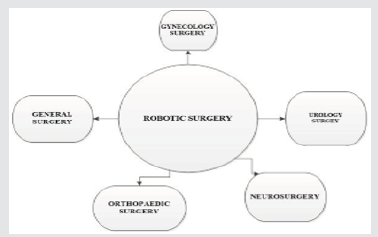
Robotics in the present times has proliferated by leaps and bounds delivering successful, precise services and solutions in a number of domains [2]. Robotics with IoT has even transformed healthcare and opened numerous avenues. Some of its key focus areas include: surgical and interventional robotics, rehabilitative robotics, clinical workforce support, elderly and people with disability care, assistive living etc [1], [7–10]. Human Surgery has typically witnessed phenomenal changes with the introduction of robotic surgery [2]. Robots are being successfully applied for a number of surgical operations as depicted in Figure 1 below:

Figure 1: Types of Robotic Surgery. .
Lupinepublishers-openaccess-robotics-mechanical-engineering-journal
Figure 1 above highlights the different avenues where robots have guided and performed minimally invasive surgeries [2]. Intuitive Surgical da Vinci robot has reportedly performed successful surgeries on almost 3 million patients worldwide [4]. They are being successfully used in neurosurgery to examine brain lesions without causing any major damage to the adjacent tissue. In orthopaedic surgeries robots shape the femur to fit prosthetic hip joint replacement with accuracy. With increased life expectancy due to better standards of living a growing demand has unfolded for assistive technologies, healthcare facilities and professionals to provide simple, affordable healthcare services to elderly people or people with disability in an unobtrusive manner. An IoT enabled solution to this demand has emerged in the form of smart homes equipped with wearable medical sensors, actuators and modern IT solutions [5]. ORCATECH Life Laboratory is one such in-house health monitoring solution [2]. Another requirement of trained health professional to provide look after and care to such patients has also been substituted by care bots to provide companionship or look after to patients [11].

Challenges in Healthcare Robotics Adoption

The advances in healthcare robotics are promising. However it is essential to still note some challenges in the domain and discuss how to overcome them. First and most importantly safety and reliability are critical to healthcare. There need to be efforts to ensure safe and gentle human-robot interactions. This especially needs to be taken care of when patients involved may be people with cognitive disabilities of kids. The next major challenge can be attributed to usability and acceptability of robots by clinicians as well as end users. This demands appropriate technical awareness and training. Only effective awareness, knowledge and training of all stakeholders involved in effective usage of healthcare robots can ensure successful usage of these robots. Another major limiting factor can be cost which includes their purchase, maintenance as well as training costs. Robot manufacturers should aim at devising techniques to manufacture and distribute well-trained and tested robots at the optimal possible costs.

Conclusion

Healthcare robotics has witnessed promising advances in the recent years. Their usage has also carved many successful stories validating their usage and application. However, how much they will be integrated into the lives of primary beneficiaries still remains unknown as this would be decided by a number of regulating environmental factors which may vary on a case to case basis as the beneficiaries involved are humans.

https://lupinepublishers.com/robotics-mechanical-engineering-journal/fulltext/smart-robotics-for-smart-healthcare.ID.000121.php

For more Lupine Publishers Open Access Journals Please visit our website: https://lupinepublishers.us/

Wednesday, 23 January 2019

Identification of the Air Supply System for Combustion, With the Help of Artificial Neural Networks (ARME)-LupinePublishers


Identification of the Air Supply System for Combustion, With the Help of Artificial Neural Networks by Deynier Montero Góngora in Advances in Robotics & Mechanical Engineering in Lupine Publishers

The production of nickel in Cuba is one of the main export items in our economy. In recent years, its production costs have risen significantly, with a high incidence of electricity costs, which is why it is necessary to take energy shock measures to reverse this situation. Currently there are deficiencies in the Reduction Furnace plant related to the control of the air supply and the electric power used by the asynchronous motors that drive the centrifugal fans, reducing the efficiency levels of the production process and the plant in general. In order to increase the energy efficiency of the combustion process supply system and reach an optimum control model of the airflow of this plant, variants are designed and simulated based on artificial neural networks that allow to establish the air demand from the drive of the fans by means of variable speed drives.


For more Lupine Publishers Open Access Journals Please visit our website
For more Robotics & Mechanical Engineering articles Please Click 
Here: www.lupinepublishers.com/robotics-mechanical-engineering-journal/index.php

Tuesday, 4 December 2018

Thermodynamics of Irreversible Process, Computerized Animated Visualization for Multi Component Mass Transport Sorption Problems in Nanocomposites (ARME)-Lupine Publishers


There  is  presented  the  author’s  mini  Review  of  the  realized  theoretical   investigation   of   the   Multi   (n=6)-component   Mass  Transfer (MMT) kinetics of the process inside the modern combined sorption “Nano-Composite” (NC) materials. The visual NC examples considered  in  the  author’s  manuscripts  may  be  represented  by  the   selective   bi-functional   NC   as   the   “Metal 0-Ion   Exchangers (IEx)”  planar  NC  L-membrane  matrix  where  the  inner  active  zero charged  “NP 0-nano-sites”  (i.e.  Nano  Particles,  Me 0-agglomerates) are imbedded into the final combined NC-IEx sorption matrix resulting after the preliminary synthesis of the final NC L-matrix considered. The computer simulation for the modelling of the MMT NC  kinetics  is  based  here  on  the  foundations  of  the  irreversible  thermodynamics   such   as   multi(n)-component   mass   balance n (6)-Eqns.  in  partial  differentials  characterized  fundamentally  by  the new k (2) (6)-“thermodynamic  variance”  (k-parameter).  


For more Lupine Publishers Open Access Journals Please visit our website
For more automation engineering books articles Please Click 
 

Additive Manufacturing for Fabrication of Robotic Components

Abstract Additive manufacturing is a promising technology in the fabrication of robotic components, because of its capability of producing...