Showing posts with label Robotics. Show all posts

Friday, 8 October 2021

Lupine Publishers | Editorial on Self-Healing Robots

 Lupine Publishers | Advances in Robotics & Mechanical Engineering

Introduction

Scientists at University of Colorado, Boulder had developed a first and fully re-healable and recyclable electronic material. This novel technology functions like properties of human skin, capable of measuring pressure, temperature and vibration. Technically, it’s a self-healing Robot - For instance if robots are wrapped in an electronic material that mimics as human skin; theoretically it can also sense objects that is too hot or too cold or if more or less pressure needs to be exerted on an object. If this material is beyond repair, then it can be soaked in a solution that separates out the silver nanoparticles then be fully recycled into new usable material [1] (Figure 1).

Figure 1: Illustrates self-healing material developed at University of Colorado, Boulder. Image Credit: Quartz [1].

Self-Healing Robots Breakthrough

Many of natural organisms have the capability to heal themselves. Now, manmade machines will be able to imitate this phenomenon. In the research Carnegie Mellon University created a self-healing material that spontaneously heals itself even under extreme mechanical damage. The soft composite material is consisting of liquid metal droplets suspended in a soft elastomer. When it is broken, the droplets rupture to form a new arrangement with adjacent droplets and redirect electrical signals without any disruption. Circuits which are created with conductive traces of such kind of material remain entirely and continuously functioning when punctured, severed or material removed. Applications for this kind of novel technology includes bio-inspired robotics, wearable, computing human and machine interaction. Because material also exhibits high electrical conductivity; it does not change when starched, theoretically, it is ideal for use in power and data transmission.

“If we have to build machines that are more compatible with the human body and natural atmosphere, then we have to begin with new material types” was confirmed by the author of the study [2,3] (Figure 2).

Figure 2: Illustrates a digital clock continues to run as damaged circuits instantaneously heal themselves, rerouting electrical signals without interruption. Image Credit: Nature Materials [3].

Delicate, Soft and Self-Healing Robot

A new class of delicate and soft, electrically activated robots are capable of imitating the expansion and contraction of natural muscles. These robots which can be designed from a wide range of low-cost materials and are able to self-sense and self-heal from electrical damage, representing a major advance in soft robotics. A challenge in the field of “soft robotics” that can imitate the versatility and performance. Nevertheless, Keplinger Research Group in the College of Engineering and Applied Science has created a novel method of a new class of soft robotics. This novel method of hydraulically intensified self-healing electrostatic actuators abjure bulky, rigid pistons and motors of conventional robots for soft structures that respond to applied voltage with comprehensive range of motions. These soft robots can accomplish a variety of jobs including holding subtle objects for instance, raspberry and a raw egg as well as lifting heavy objects. These new tech robots actuators exceed the strength, speed and efficiency of biological muscle and their flexibility. In addition to assisting as hydraulic fluid which supports flexible movements, the use of liquid insulating layer enables robots’ actuators to self-heal from electrical damage. Another soft actuator that are controlled by high voltage, also known as dielectric elastomer actuators; it utilizes a solid insulating layer that fails catastrophically from electrical damage [4-6] (Figure 3).

Figure 3: Illustrates actuators can be designed as soft grippers to handle and manipulate delicate objects, like this raspberry. Image Credit: Keplinger Lab / University of Colorado Boulder [6].

Graphene for Artificial Skin in Self-Healing Robots

Graphene is a sheet of pure carbon atoms and it is known as world’s strongest material; it is one million times thinner than paper. It is so thin that it can be viewed as two dimensional. Although, it’s hefty price, graphene has become most favorable nanomaterials due to its unique and multipurpose applications. One of the organs in the human body; skin is known for its fascinating self-healing properties. Imitating this phenomenon has proved too much of work as manmade materials lack this technology. Due to stretching or bending and incidental scratches, artificial skin used in robots are too much susceptible to ruptures and fissures. In this study a novel solution where a sub-nano sensor uses graphene to sense a crack as soon as it starts nucleation even after the crack has spread a certain distance. Scientist subjected a single layer graphene comprising various issues like pre-existing vacancies and inversely oriented pre-existing cracks to uniaxial tensile loading till fracture. Once it is completed, graphene started to heal and the self-healing continued irrespective of the nature of pre-existing issues in the graphene sheet. Not to mention, whatever the length of crack, they were all healed; provided the critical crack opening distance are within 0.3 to 0.5nm for pristine sheet and sheet with pre-existing defects [7,8].

Wolverine Inspired Material for Self-Healing Robot

Researchers at University of California, Riverside designed a novel method of an ionic conductor, that means material that ions can flow through and it is mechanically stretchable, transparent and self-healing. These materials have wide variety of applications in extensive range of fields. It can give robots to self-heal after mechanical failure. It also extends the lifetime of lithium ion batteries used in electronics and electric cars; and improve biosensors that are used in medical and environmental fields. This material was inspired by wound healing in nature, self-healing materials repair the damage caused by wear and extend the lifetime and in turn lowering the cost of the device. Ionic conductors are a class of materials with vital roles in energy storage, sensors, solar energy conversion and electronic devices.

The vital problem is the identification of bonds that are stable and reversible under electrochemical conditions. Traditionally, selfregenerative polymers utilize non-covalent bonds which makes it difficult because these bonds are affected by electrochemical reactions that decreases the performance of the materials. Wang solved that critical problem by utilizing a novel mechanism that is known as ion-dipole interactions; the forces between charged ions and polar molecules that are highly stable under electrochemical conditions. In this method, he joined a stretchable polymer with mobile and high ionic strength salt to create material with the properties that scientist was searching. It is a low cost and can be easily produce soft rubber like material that can stretch 50 times its original length. If it has been cut, it can completely heal in 24 hours at room temperature. As a matter of fact, after only five minutes of healing the material can be stretched two times its original length [9,10] (Figure 4).

Figure 4: Illustrates showing self-healing via ion-dipole interaction. Image Credit: University of Colorado, Boulder [10].

Robots That Can Morph Metal Shapes

Researchers created a novel hybrid material that is stiff metal, soft and porous rubber foam that integrates the best properties of stiffness and as well as elasticity when a change of shape is necessary. This material also has the capability of self-heal if damaged. This material integrates with the soft alloy called Field’s metal with a porous silicone foam and the rigidity and load bearing capability of humans with the capability to drastically alter shape, like an octopus. In addition to this, its melting point is 144 degrees Fahrenheit, the major reason Field’s metal was taken because it has no lead in it. The elastomer foam is immersed into a molten metal then it is placed in a vacuum so that the air in the foam’s pores are removed and interchanged by the alloy. The foam had pore sizes of around 2 millimeters that can be adjusted to make a stiffer or more flexible material. In testing of its strength and elasticity the material ability was deformed when heated above 144 degrees, then it regained rigidity when cooled; then it returned to its original shape and strength when reheated [11,12] (Figure 5).


https://lupinepublishers.com/robotics-mechanical-engineering-journal/fulltext/editorial-on-self-healin-robots.ID.000124.php

https://lupinepublishers.com/robotics-mechanical-engineering-journal/pdf/ARME.MS.ID.000124.pdf

For more Lupine Publishers Open Access Journals Please visit our website: https://lupinepublishersgroup.com/

For more Robotics & Mechanical Engineering Please Click Here:

https://lupinepublishers.com/robotics-mechanical-engineering-journal/

To Know more Open Access Publishers Click on Lupine Publishers

Follow on Linkedin : https://www.linkedin.com/company/lupinepublishers

Follow on Twitter   :  https://twitter.com/lupine_online


Tuesday, 26 November 2019

Lupine Publishers | Research on Fishery Water Quality Detection System of Unmanned Aerial Vehiclee


Lupine Publishers | Advances in Robotics & Mechanical Engineering

Abstract

Many lands in China are close to rivers and oceans and they are very suitable for developing fisheries. Water quality monitoring is indispensable to the development of fisheries. Therefore, a method of detecting, evaluating and predicting fishery water quality using unmanned aerial vehicle electrode sensor array is proposed. The results show that this method can timely monitor fishery water quality and predict the future trend of water quality and improve the detection efficiency.
Keywords: Fishery water; Prediction; Electrode Sensor Array; UAV

Introduction

Among the standards for measuring fishery water quality [1], the PH value of fishery water, ammonia nitrogen content, temperature, dissolved oxygen are important data indicators for traditional fish farming, which have a direct impact on fish farming. In the traditional analysis and prediction of fishery water quality, it takes a long time to sample fishery water and then carry out physical and chemical analysis, which will greatly delay the timely management of fishery water and resulting in irreversible losses. Therefore, it is necessary to find a faster, more convenient and reliable method. As far as we know, the electrode electrochemical sensors have the characteristics of fast equivalent circuit network, high selectivity of measurement, the excellent waterproof performance and corrosion resistance. It is an excellent choice for fishery water quality monitoring. At the same time, due to UAV’s [2] high mobility and flexibility, outstanding performance and practical application in the agricultural field, UAV has expanded our thinking of using it in the fishery field. In this paper, we focus on the application of electrodetype chemical water quality sensors in fishery production practice [3], and carry them on the platform, and transmit the data to the cloud database through GPRS network for LSTM [4], in order to achieve more accurate and rapid assessment and prediction of fishery water quality in modern aquaculture.

Methods

UAV Suitable for Water Surface

In order to ensure UAV to float smoothly on the water surface and leave the water quickly, the floating structure can be made of ethylene-vinyl acetate copolymer (EVA). EVA [5] is a polymeric material whose molecular formula is (C2H4) x. (C4H6O2) y, which is made of foam after foaming. It has the characteristics of closed cell structure, no water absorption, good water resistance, corrosion resistance, high resilience and high tensile resistance and EVA material has a good processing property and is easy to process floating structure.

Electrode Chemical Sensor Array

Most of the electrode chemical sensors are based on chemical electrolyte as the medium, belonging to the primary battery system. After contacting fishery water, the substances to be measured are exchanged through the thin film, and the electrolyte inside can take place electrolytic reaction to produce corresponding electrical signals. For different detection components, the electrolyte inside the electrode chemical sensor is different, and the film material is selective, so the electrode chemical sensor has the characteristics of high selectivity and reliability. Although the temperature will affect the sampling results of multiple electrode chemical sensors. However, by integrating the electrode chemical sensor with the temperature sensor, the data measured by the electrode chemical sensor can be corrected by the temperature sensor.

Collection of Fishery Water Data

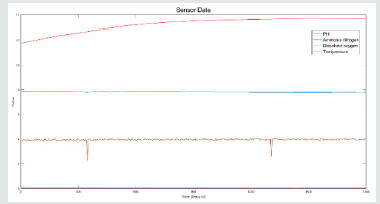
We use remote controllers, computer terminal ground stations and GPS satellite positioning to allow UAV to fly on planned routes and land accurately in the water quality area to be measured. After the UAV is parked on the water surface, sensors hidden in EVA materials begin to monitor the water quality. Each group of data contains temperature and content. There are three groups of data. After average processing, the data are transmitted to the cloud server database, which is aggregated into the server database at intervals. During floating sampling, data is transmitted only to the cloud server. After floating sampling, the collected data are sent back to the back end, and the data are evaluated and processed. The final results will be displayed at the corresponding ports of the ground station. The original working data obtained in an evaluation operation are shown in the following Figure 1.
Figure 1: The original data measured by the sensor. .

Data Processing and Results

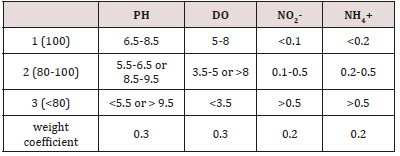
The four indicators measured by the sensor are uploaded to the cloud server after taking the average value, and the data are uploaded every 3 seconds. After every period of time, the data uploaded during that period are aggregated at the back end, and the aggregated data are processed. The processed experimental data are compared with the fishery water quality measurement standard, and the possible results are predicted, and the phase is given. The corresponding solution. Data processing mainly uses LSTM algorithm. LSTM can perform better in a longer sequence than ordinary RNN. LSTM differs from RNN in that it adds a “processor” to the algorithm to judge whether information is useful or not. The structure of the processor is called cell. According to the fishery water quality measurement standard, we divide the water quality grade into the following tables: (Table 1). Through the analysis of the original working data, it can be concluded that PH is basically stable between 7.7 and 7.9, DO is about 3.8–3.9, NO2 is between 0.09–0.1, NH4+ is between 0.1 and 0.11, the temperature is increasing, and the fishery water level is 2. The experimental results after treatment are extracted as follows: (Table 2). It can be seen from the table that the experimental results after treatment are basically consistent with the analysis.
Table 1: Classification.
Table 2: Analysis result.

Summary

This paper reviews the composition of UAV water quality monitoring system and its corresponding algorithm, analyses in detail the details of UAV water quality monitoring system operation and introduces the application of LSTM algorithm in it. From the current performance effect, the UAV water quality monitoring system has a significant effect, which also confirms the shortcomings of the traditional fishery water quality monitoring system.
For more Lupine Publishers Open Access Journals Please visit our website:
http://lupinepublishers.us/
For more Advances in Robotics & Mechanical Engineering Please Click Here:
https://lupinepublishers.com/robotics-mechanical-engineering-journal/
To Know More About Open Access Publishers Please Click on Lupine Publishers

Follow on Linkedin : https://www.linkedin.com/company/lupinepublishers
Follow on Twitter   :  https://twitter.com/lupine_online

Wednesday, 9 January 2019

Insight into Bio Inspired Robotics (ARME)-LupinePublishers


Insight into Bio Inspired Robotics by Sadique Shaikh in Advances in Robotics & Mechanical Engineering in Lupine Publishers

I am trying to understand whole family of Biology and Synthetic Biology inspired robotics through this piece of communication. Broadly with assuming their sub categories in them I would like classify bio inspired robotics in to five major heads are Cyborg, Cylons, Soft robotics, Continuum robotics, Plantoids and Nanobots. Where Soft robots and Plantoids are quite new and interesting domains of new future of AI in many forms with advanced features. This opinion gives in your notice all about them.

https://lupinepublishers.com/robotics-mechanical-engineering-journal/abstracts/insight-into-bio-inspired-robotics.ID.000111.php
https://lupinepublishers.com/robotics-mechanical-engineering-journal/pdf/ARME.MS.ID.000111.pdf
https://lupinepublishers.com/robotics-mechanical-engineering-journal/fulltext/insight-into-bio-inspired-robotics.ID.000111.php


For more Lupine Publishers Open Access Journals Please visit our website
For more Lupine Publisehrs reivew, arme  Please Click 

Tuesday, 27 November 2018

Use of Latest Robots for Autism Spectrum Disorder (ARME)-Lupinepublishers


One of the prominent applications of robots is in assistive therapy using humanoids. Robots are now playing a vital role in our lives as assistants, therapist, companions and much more. Autism Spectrum Disorder (ASD) affects the communication skills and social cues of a person considerably. Recently efforts have been made in the development of communicational, behavioral, motor movements, joint attention and physical behavior of the children suffering from ASD using the humanoid robots. The therapies based on interactive interventions using robots for ASD have proved to be a favorable tool for improving the behavior of children with ASD. There are different ways to identify and improve the behavior in ASD child e.g. psychologists’ sessions, computer vision based bio markers like joint attention measurement and gait analysis, and robot assisted therapies using Autism Observation Scale for Infants (AOSI). In particular the area of robotics is helping a lot in the treatment of ASD as the robot acts as a mediator as well as measures the response of an autistic child.

For more Lupine Publishers Open Access Journals Please visit our website
For more robotics journals impact factor  articles Please Click 


Additive Manufacturing for Fabrication of Robotic Components

Abstract Additive manufacturing is a promising technology in the fabrication of robotic components, because of its capability of producing...