Lupine Publishers | Robotics & Mechanical Engineering (ARME) is an International open access, peer-reviewed journal which offers prompt publication of articles covering experimental, numerical and theoretical investigations which give insight into the major areas of mechanical
Showing posts with label Robotics Journal Ranking. Show all posts
Showing posts with label Robotics Journal Ranking. Show all posts
Tuesday, 26 November 2019
Lupine Publishers | Research on Fishery Water Quality Detection System of Unmanned Aerial Vehiclee
Lupine Publishers | Advances in Robotics & Mechanical Engineering
Abstract
Many lands in China are close to rivers and oceans and they are very suitable for developing fisheries. Water quality monitoring is indispensable to the development of fisheries. Therefore, a method of detecting, evaluating and predicting fishery water quality using unmanned aerial vehicle electrode sensor array is proposed. The results show that this method can timely monitor fishery water quality and predict the future trend of water quality and improve the detection efficiency.
Among the standards for measuring fishery water quality [1], the PH value of fishery water, ammonia nitrogen content, temperature, dissolved oxygen are important data indicators for traditional fish farming, which have a direct impact on fish farming. In the traditional analysis and prediction of fishery water quality, it takes a long time to sample fishery water and then carry out physical and chemical analysis, which will greatly delay the timely management of fishery water and resulting in irreversible losses. Therefore, it is necessary to find a faster, more convenient and reliable method. As far as we know, the electrode electrochemical sensors have the characteristics of fast equivalent circuit network, high selectivity of measurement, the excellent waterproof performance and corrosion resistance. It is an excellent choice for fishery water quality monitoring. At the same time, due to UAV’s [2] high mobility and flexibility, outstanding performance and practical application in the agricultural field, UAV has expanded our thinking of using it in the fishery field. In this paper, we focus on the application of electrodetype chemical water quality sensors in fishery production practice [3], and carry them on the platform, and transmit the data to the cloud database through GPRS network for LSTM [4], in order to achieve more accurate and rapid assessment and prediction of fishery water quality in modern aquaculture.
Methods
UAV Suitable for Water Surface
In order to ensure UAV to float smoothly on the water surface and leave the water quickly, the floating structure can be made of ethylene-vinyl acetate copolymer (EVA). EVA [5] is a polymeric material whose molecular formula is (C2H4) x. (C4H6O2) y, which is made of foam after foaming. It has the characteristics of closed cell structure, no water absorption, good water resistance, corrosion resistance, high resilience and high tensile resistance and EVA material has a good processing property and is easy to process floating structure.
Electrode Chemical Sensor Array
Most of the electrode chemical sensors are based on chemical electrolyte as the medium, belonging to the primary battery system. After contacting fishery water, the substances to be measured are exchanged through the thin film, and the electrolyte inside can take place electrolytic reaction to produce corresponding electrical signals. For different detection components, the electrolyte inside the electrode chemical sensor is different, and the film material is selective, so the electrode chemical sensor has the characteristics of high selectivity and reliability. Although the temperature will affect the sampling results of multiple electrode chemical sensors. However, by integrating the electrode chemical sensor with the temperature sensor, the data measured by the electrode chemical sensor can be corrected by the temperature sensor.
Collection of Fishery Water Data
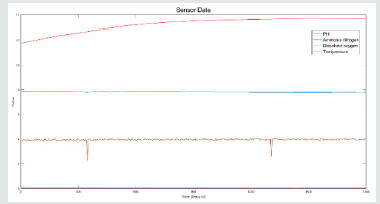
We use remote controllers, computer terminal ground stations and GPS satellite positioning to allow UAV to fly on planned routes and land accurately in the water quality area to be measured. After the UAV is parked on the water surface, sensors hidden in EVA materials begin to monitor the water quality. Each group of data contains temperature and content. There are three groups of data. After average processing, the data are transmitted to the cloud server database, which is aggregated into the server database at intervals. During floating sampling, data is transmitted only to the cloud server. After floating sampling, the collected data are sent back to the back end, and the data are evaluated and processed. The final results will be displayed at the corresponding ports of the ground station. The original working data obtained in an evaluation operation are shown in the following Figure 1.
Figure 1: The original data measured by the sensor. .
Data Processing and Results
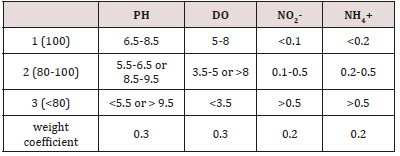
The four indicators measured by the sensor are uploaded to the cloud server after taking the average value, and the data are uploaded every 3 seconds. After every period of time, the data uploaded during that period are aggregated at the back end, and the aggregated data are processed. The processed experimental data are compared with the fishery water quality measurement standard, and the possible results are predicted, and the phase is given. The corresponding solution. Data processing mainly uses LSTM algorithm. LSTM can perform better in a longer sequence than ordinary RNN. LSTM differs from RNN in that it adds a “processor” to the algorithm to judge whether information is useful or not. The structure of the processor is called cell. According to the fishery water quality measurement standard, we divide the water quality grade into the following tables: (Table 1). Through the analysis of the original working data, it can be concluded that PH is basically stable between 7.7 and 7.9, DO is about 3.8–3.9, NO2 is between 0.09–0.1, NH4+ is between 0.1 and 0.11, the temperature is increasing, and the fishery water level is 2. The experimental results after treatment are extracted as follows: (Table 2). It can be seen from the table that the experimental results after treatment are basically consistent with the analysis.
Table 1: Classification.
Table 2: Analysis result.
Summary
This paper reviews the composition of UAV water quality monitoring system and its corresponding algorithm, analyses in detail the details of UAV water quality monitoring system operation and introduces the application of LSTM algorithm in it. From the current performance effect, the UAV water quality monitoring system has a significant effect, which also confirms the shortcomings of the traditional fishery water quality monitoring system.
I was started my research only with one thinking “How we feel and understand sadness or happiness of others, why our eyes
sometime filled with tears, when we see others crying or sad, why we cheer up when we see others happy, why we bless others,
why we care for others, why we become sad when we watch sad seen in movies, why we motivate when we watch something
exciting and meaningful in movies, why, why and why?” these are the big questions front of us. My common answer which support
to all these questions is “when situation is common between two or more than two people they completely understand each other,
because their brains neurons handling same situation. Some time may be feelings for other because of past common situation of us
is the present situation of someone or may be some time we think if that situation on me what I would do. Hence common situation
either good or bad doesn’t matter but common situation people show strong feelings about each other with respecting emotions
and feelings of each other’s and this is because “common situation setup brain-to-brain link between people through which they
understand feelings and emotions of each other [1].
Smart agriculture is a cyber-physical agriculture management concept
involved in the observing, measuring and responding
variability of crops in the agriculture management cycle. This paper is
devoted to the intelligent robotics for smart agriculture.
After the robotics demand analysis, the key technologies are proposed
step by step, including robotics vision modeling and decision
making, robotics pattern recognition and human-computer interaction
decision, robotics function development and test verification.